
Exercising at Home Without Equipment is one of the most effective, accessible ways to burn calories, build lean muscle mass, and improve cardiovascular health. Millions of busy adults face common fitness obstacles every day, including lack of time, expensive gym memberships, plateauing weight loss, severe fatigue, improper tracking, and fears of losing muscle mass during weight loss journeys.
Understanding the science of your body transforms how you approach home workouts. When you combine structured bodyweight training with accurate daily calorie tracking and proper macro distribution, you unlock sustainable progress without stepping foot inside a commercial facility. Scientific health tracking directly impacts your safety, workout recovery, daily energy levels, and long-term vitality.
This comprehensive guide breaks down step-by-step home workout routines, exact calorie and macro calculations, progressive overload strategies without weights, and practical fat loss methods designed specifically for busy daily commuters, home workers, and fitness enthusiasts across the United States.
The Science of Bodyweight Fitness and Metabolic Health
Building strength and burning fat at home relies on fundamental physiological principles. Your body does not know the difference between a hundred-dollar dumbbell and its own gravitational weight. It simply responds to mechanical tension, metabolic stress, and muscle damage.
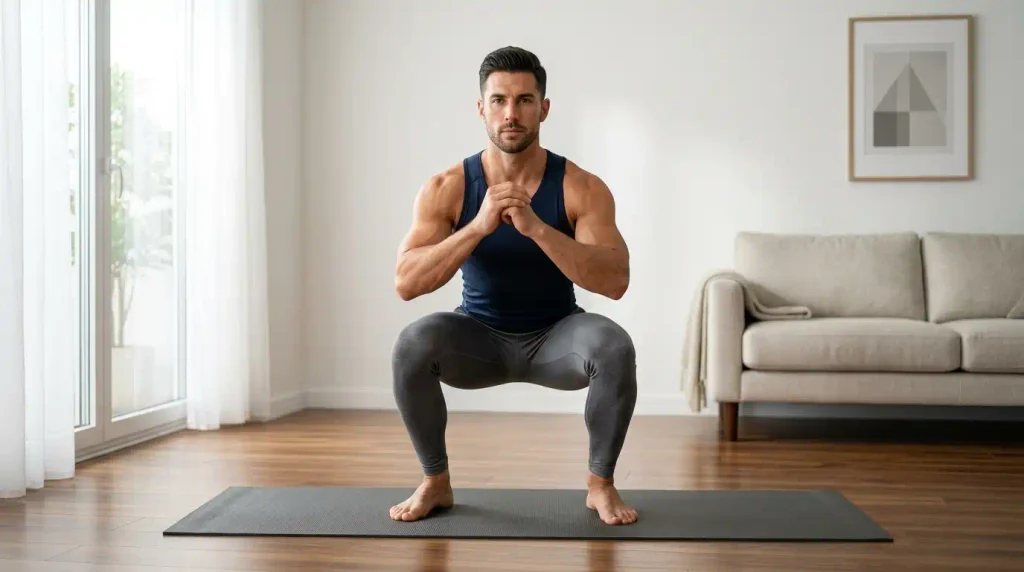
When you perform bodyweight exercises like push-ups, squats, and lunges, your skeletal muscles contract against gravity. This contraction stimulates muscle protein synthesis, increases heart rate, and elevates your overall daily calorie expenditure.
Understanding key metabolic terms helps you optimize your workouts and nutrition plans:
- Basal Metabolic Rate (BMR): The absolute minimum number of calories your body requires to perform basic life-sustaining functions at rest, such as breathing, blood circulation, and cell production.
- Total Daily Energy Expenditure (TDEE): The total number of calories you burn in a 24-hour period. TDEE accounts for your BMR, physical activity, bodyweight exercises, and the thermic effect of food.
- Caloric Deficit: A state where you consume fewer calories than your TDEE demands. A consistent caloric deficit forces your body to tap into stored body fat for energy.
- Progressive Overload: The continuous increase of physical stress placed on the musculoskeletal system during exercise to stimulate continuous muscle growth and strength adaptations.
- Lean Muscle Mass: The total weight of your muscle tissue, bone density, organs, and body water, excluding essential and non-essential body fat.
- Macro Distribution: The daily breakdown of your total calorie intake divided into the three primary macronutrients: proteins, carbohydrates, and fats.
Key Takeaway: Bodyweight training acts as a powerful tool for metabolic resistance training. By increasing daily energy expenditure and preserving lean muscle mass, home exercise supports long-term fat loss and structural health.
How Bodyweight Training Compares to Traditional Gym Workouts
Many adults worry that exercising without equipment provides inferior results compared to weight-lifting in a gym. Research in exercise physiology demonstrates that bodyweight exercises deliver comparable muscle strength gains and body composition improvements when sets are taken close to muscular fatigue.
Cardio vs. Strength Burn Rates at Home
| Exercise Category | Primary Energy System | Average Calorie Burn per 30 Mins (160 lb Person) | Primary Fitness Benefit |
| High-Intensity Interval Training (HIIT) | Anaerobic & Aerobic | 280 – 360 Calories | High post-workout calorie burn, improved VO2 max |
| Bodyweight Strength Training | Anaerobic Glycolytic | 180 – 240 Calories | Muscle preservation, joint stability, structural strength |
| Steady-State Bodyweight Cardio | Aerobic System | 200 – 250 Calories | Heart health, endurance, stress reduction |
| Low-Impact Mobility Work | Aerobic / Recovery | 90 – 120 Calories | Active recovery, flexibility, joint lubrication |
Combining both strength-focused bodyweight exercises and aerobic cardio movements creates the ultimate home routine. Bodyweight strength training preserves your lean muscle mass during a calorie deficit, ensuring that the weight you lose comes primarily from fat rather than muscle tissue.
Mastering Progressive Overload Without Equipment
The primary challenge of home workouts is increasing the workout difficulty when you cannot simply add heavy weight plates. Progressive overload without equipment requires creative manipulation of mechanical leverage, movement tempo, training volume, and rest intervals.
5 Ways to Apply Progressive Overload at Home
- Increase Movement Range of Motion: Perform deeper squats, elevated push-ups, or deficit lunges to recruit more muscle fibers per repetition.
- Slow Down Movement Tempo: Control the eccentric (lowering) phase of an exercise for three to four seconds to maximize muscle tension.
- Decrease Rest Intervals: Reduce recovery periods between sets from 60 seconds down to 30 seconds to increase metabolic stress and cardiovascular demand.
- Increase Repetitions and Sets: Gradually perform more repetitions per set or add an additional total set to your exercise routine each week.
- Unilateral Progression: Advance from double-leg or double-arm exercises to single-leg squats (pistol squats) or single-arm elevated push-ups to double the effective load.
Complete No-Equipment Home Workout Routines
To optimize health and fat loss, structured routine variations keep your workouts engaging and physically effective. Below are three complete bodyweight routines tailored for different experience levels and goals.
Routine 1: Full-Body Beginner Circuit (3 Days per Week)
Perform this circuit three times through. Rest 60 seconds between exercises and two minutes between complete rounds.
- Bodyweight Squats: 12 to 15 repetitions. Focus on keeping chest high and pushing hips back.
- Incline Push-Ups (Hands on Wall or Countertop): 10 to 12 repetitions. Keep your core tight and elbows angled at 45 degrees.
- Glute Bridges: 15 repetitions. Squeeze your glutes tightly at the top of the movement for two full seconds.
- Doorway or Incline Bodyweight Rows: 10 to 12 repetitions. Focus on pulling your shoulder blades back together.
- Stationary Reverse Lunges: 10 repetitions per leg. Step backward smoothly while keeping front knee tracking over toes.
- Plank Hold: 20 to 30 seconds. Maintain a straight line from your ears down to your ankles.
Routine 2: Intermediate Fat Loss HIIT Circuit (4 Days per Week)
Perform each movement for 40 seconds, followed by 20 seconds of rest. Complete 4 total rounds.
- Jump Squats or Speed Squats: Explosive extension through hips, landing softly on the mid-foot.
- Standard Floor Push-Ups: Lower chest to two inches above floor level, driving up powerfully.
- Alternating Speed Lunges: Quick, controlled backward lunges with rhythmic arm action.
- Mountain Climbers: Fast knees-to-chest motion in a rigid plank position.
- Pike Push-Ups: Hips elevated high in an inverted V-shape to target shoulders and upper chest.
- Bicycle Crunches: Alternate elbow to opposite knee with fully extended lower legs.
Routine 3: Advanced Bodyweight Muscle Builder (4 to 5 Days per Week)
Perform 4 sets of each exercise, pushing within 1 to 2 repetitions of total muscular failure. Rest 90 seconds between sets.
- Decline Push-Ups (Feet Elevated on Couch or Chair): 12 to 20 repetitions.
- Bulgarian Split Squats (Rear Foot Elevated): 10 to 15 repetitions per leg.
- Pike Push-Ups or Wall Walks: 8 to 12 repetitions.
- Single-Leg Glute Bridges: 12 to 15 repetitions per leg.
- Chair Dips (Keep Knees Bent or Legs Straight): 12 to 15 repetitions.
- Plank-to-Push-Up Transitions: 10 to 12 total repetitions.
Safety Tip: Always execute a 5-minute dynamic warm-up before initiating high-intensity exercises. Include arm circles, torso twists, leg swings, and light marching to lubricate joints and elevate core body temperature.
Energy Balance: Calculating Your Daily Calories and BMR
Exercise acts as the catalyst for fitness gains, but energy intake determines your overall body weight and composition changes. To lose fat sustainably while exercising at home, you must maintain a strategic daily calorie deficit without starving your body or causing extreme fatigue.
Step 1: Calculate Your Basal Metabolic Rate (BMR)
Use the scientifically validated Mifflin-St Jeor equation to estimate your resting BMR in imperial units (pounds and inches converted to metric equivalents internally).
- Men: BMR = (10 x weight in kg) + (6.25 x height in cm) – (5 x age in years) + 5
- Women: BMR = (10 x weight in kg) + (6.25 x height in cm) – (5 x age in years) – 161
Quick Conversion Reference: Weight in kg = weight in lbs / 2.2. Height in cm = height in inches x 2.54.
Step 2: Determine Your Total Daily Energy Expenditure (TDEE)
Multiply your calculated BMR by an Activity Factor that matches your daily lifestyle and workout frequency:
- Sedentary (Little to no exercise, desk job): BMR x 1.2
- Lightly Active (Home workouts 1 to 3 days per week): BMR x 1.375
- Moderately Active (Moderate workouts 3 to 5 days per week): BMR x 1.55
- Very Active (Hard bodyweight workouts 6 to 7 days per week): BMR x 1.725
Step 3: Set Your Target Calorie Deficit
To target safe, long-term fat loss of 1 to 2 lbs per week, establish a moderate daily calorie deficit based on your baseline TDEE.
| Activity Level & Goal | TDEE Adjustment | Intended Target Fat Loss Rate | Primary Focus |
| Conservative Fat Loss | 10% to 15% Deficit | 0.5 to 1.0 lb per week | Ideal for beginner exercisers, high energy preservation |
| Moderate Fat Loss | 20% Deficit | 1.0 to 1.5 lbs per week | Recommended balance of steady fat loss and workout performance |
| Aggressive Fat Loss | 25% Deficit | 1.5 to 2.0 lbs per week | Short-term fat loss, requires strict macro monitoring |
| Muscle Maintenance / Recomp | 0% (Maintenance Calories) | 0.0 lbs (Recomposition) | Build bodyweight strength while burning fat slowly |
Crucial Warning: Never drop your daily intake below your BMR or under 1,200 calories per day for women and 1,500 calories per day for men without direct medical supervision. Extreme deficit leads to thyroid down-regulation, muscle loss, severe fatigue, and hormonal imbalance.
Optimizing Macronutrients for Home Workout Recovery
Calories determine how much weight you lose or gain, but macronutrients determine what kind of weight you lose or gain. Consuming adequate protein during a home workout regimen prevents muscle breakdown and supports repair.
Macro Distribution Breakdown Guidelines
- Protein Intake: Aim for 0.8 to 1.0 gram of protein per pound of target body weight daily (1.8 to 2.2 grams per kilogram). Protein maximizes muscle protein synthesis and increases satiety.
- Dietary Fats: Set dietary fat intake to 20% to 30% of your total daily calories. Essential fatty acids support hormone production, brain health, and joint health.
- Carbohydrates: Fill your remaining daily calories with complex carbohydrates. Carbohydrates replenish glycogen stores in muscle tissue, providing energy for intense workouts.
Recommended Daily Macro Distribution Ratios
| Fitness Goal | Protein (% Calories) | Carbohydrates (% Calories) | Dietary Fats (% Calories) |
| Fat Loss & Lean Muscle Retention | 35% to 40% | 30% to 35% | 25% to 30% |
| General Fitness & Maintenance | 25% to 30% | 40% to 45% | 25% to 30% |
| Endurance & High-Volume Cardio | 20% to 25% | 50% to 55% | 20% to 25% |
Strategic Meal Prep Tips for Busy Home Exercisers
- Prioritize Lean Protein Sources: Base meals around chicken breast, turkey, eggs, wild-caught salmon, Greek yogurt, tofu, lentils, and quality whey or plant protein powders.
- Focus on Fiber-Dense Carbohydrates: Choose oats, brown rice, sweet potatoes, quinoa, berries, and green cruciferous vegetables to slow down digestion and maintain steady blood sugar.
- Include Healthy Fats: Incorporate measured portions of avocados, extra virgin olive oil, almonds, seeds, and natural peanut butter into your daily diet.
- Practice Pre-Portioned Batch Cooking: Prepare 3 to 4 days worth of lean protein and complex carbs in advance to avoid emotional impulse eating during busy workdays.
Heart Rate Zones and Aerobic Conditioning at Home
Tracking your exercise intensity ensures you target the correct metabolic pathways during home cardio sessions. Heart rate zones offer an objective measurement of how hard your cardiovascular system works during exercise.
How to Calculate Your Estimated Max Heart Rate
Calculate your maximum heart rate (MHR) using the simple formula: 220 – Age = Estimated Max HR.
- Example: For a 40-year-old individual, estimated Max HR = 220 – 40 = 180 beats per minute (bpm).
Heart Rate Zone Breakdown for Home Workouts
- Zone 1 (Warm-Up / Active Recovery): 50% to 60% of Max HR. Ideal for light walking, light mobility, and recovery between intense workout sets.
- Zone 2 (Aerobic Endurance / Base Building): 60% to 70% of Max HR. Excellent for sustained bodyweight cardio circuits, building mitochondrial density, and fat oxidation.
- Zone 3 (Tempo / Aerobic Power): 70% to 80% of Max HR. Moderate-to-hard intensity bodyweight training that improves cardiovascular efficiency.
- Zone 4 (Anaerobic Threshold / HIIT): 80% to 90% of Max HR. High-intensity bodyweight intervals that raise lactic acid tolerance and maximize post-workout calorie burn.
- Zone 5 (Maximal Effort): 90% to 100% of Max HR. All-out sprints or high-speed bodyweight bursts maintained for short durations (10 to 30 seconds).
Overcoming Common Home Workout Plateaus and Fatigue
It is common to hit plateaus during home workout programs. As your body loses weight and adapts to exercise stress, your TDEE naturally decreases because a lighter body requires less energy to move.
4 Proven Strategies to Break Home Workout Plateaus
- Recalculate Your TDEE and Calories Every 5 to 10 Pounds Lost: As your total body weight drops, adjust your daily calorie intake downward slightly to maintain a continuous, effective calorie deficit.
- Audit Your Daily Food Tracking: Uncounted oils, dressings, sauces, and small snacks can quickly erase a 300-calorie deficit. Use a digital food scale to weigh foods accurately.
- Increase Non-Exercise Activity Thermogenesis (NEAT): NEAT includes all movement outside of structured exercise, such as pacing, doing household chores, and taking daily steps. Aim for 7,000 to 10,000 daily steps.
- Implement a Scheduled Diet Break / Refeed Week: If you experience severe fatigue, constant hunger, or stalled weight loss after 8 to 12 weeks of dieting, bring your calories back up to maintenance level for 7 days to restore thyroid performance and lower stress hormones.
Frequently Asked Questions (PAA Fitness Search Intent)
Can you really build muscle and lose weight at home without any equipment?
Yes, you can build muscle and lose fat at home without equipment. Bodyweight exercises create mechanical tension on your muscle fibers. By applying progressive overload (adjusting repetitions, tempo, and leverage) alongside a sufficient protein intake and proper calorie deficit, you effectively stimulate muscle growth while losing body fat.
How many calories do home bodyweight workouts actually burn?
A typical 30-minute home bodyweight routine burns between 180 and 360 calories, depending on your body weight, workout intensity, and exercise selection. High-Intensity Interval Training (HIIT) circuits sit at the higher end of calorie burn, while controlled bodyweight strength exercises sit in the middle range.
What is the ideal daily calorie deficit for safe fat loss?
The optimal daily calorie deficit for long-term success is 15% to 20% below your Total Daily Energy Expenditure (TDEE). This calorie range equates to losing approximately 1 to 1.5 pounds of fat per week without causing muscle loss, metabolic slowdown, or extreme energy fatigue.
Are bodyweight cardio exercises better than weight training for losing belly fat?
Spot reduction of body fat from specific areas like the abdomen is physiologically impossible. Both bodyweight cardio and bodyweight strength exercises help you burn fat across your entire body by contributing to an overall calorie deficit. Combining bodyweight strength exercises with cardio intervals provides the ultimate fat loss result.
What are the main signs of overtraining during home workouts?
Signs of overtraining include chronic muscle soreness lasting over 72 hours, elevated resting heart rate upon waking, persistent insomnia or restless sleep, extreme daily fatigue, loss of motivation, frequent illness, and unexplainable stalls in strength and weight loss progress.
How many days a week should a beginner exercise at home?
Beginners should aim to perform full-body bodyweight workouts 3 days per week on non-consecutive days (such as Monday, Wednesday, and Friday). On off days, engage in light active recovery like walking or gentle stretching to promote blood flow and recovery.
How do I stop losing muscle while trying to lose weight at home?
To preserve lean muscle mass during weight loss, consume 0.8 to 1.0 gram of protein per pound of target body weight daily, perform resistance-focused bodyweight exercises 3 to 4 days per week, and maintain a moderate calorie deficit rather than an extreme starvation diet.
Conclusion and Key Takeaways
Exercising at home without equipment offers a flexible, highly effective, and sustainable route to ultimate health, strength, and body transformation. You do not need expensive commercial gym tools to achieve a healthy body composition, improve cardiovascular heart health, or hit your weight loss goals.
Summary of Next Steps
- Master the Fundamentals: Perform bodyweight exercises with strict form, full range of motion, and controlled movement tempos.
- Apply Progressive Overload: Continually challenge your muscles by increasing repetitions, reducing rest intervals, or advancing to tougher movement variations.
- Calculate Your Energy Needs: Determine your unique BMR and TDEE to set a precise daily calorie deficit for steady fat loss.
- Prioritize Protein & Recovery: Fuel your body with sufficient lean protein, complex carbs, healthy fats, and adequate daily sleep to bounce back strong from workouts.
- Track Your Real Progress: Monitor body weight, energy levels, physical measurements, and workout performance consistently to make smart, data-driven adjustments.
To eliminate guesswork and start your personalized fitness plan today, know your exact daily energy needs. Test your exact numbers right now using the free Calorie & Fitness Calculators at DailyFitness.online to instantly discover your personalized BMR, TDEE, daily calorie deficit target, and ideal macro breakdown!

Al Muktadir Arefin is a certified exercise physiologist and wellness expert with over 15 years of hands-on experience in fitness coaching and nutrition. He earned his Master’s degree in Kinesiology and Exercise Science from the University of Florida. Combining solid academic research with practical, real-world training methods, Muktadir specializes in creating evidence-based fitness strategies that help individuals achieve sustainable long-term health.